



Prescription Lenses
How prescription lenses are made?
Each prescription dive mask is created through a precise optical process.
We use optical glass lenses, made from the finest mineral material used in precision optics when optical clarity and accuracy are essential. You can find similar technology in high-tech optical lasers, microscopes, and military solutions.
Optical glass lenses are chemically bonded to the original tempered glass lens of the dive mask. The prescription lens is placed on the inner surface of the mask, where it permanently joins the mask's tempered glass lens.
This specialized chemical bonding process ensures a strong, stable connection between the materials, resulting in a long-lasting, optically precise outcome.
Choosing the right lenses is an important part of creating your prescription dive mask.
We offer different lens types depending on how you normally correct your vision. All lenses are made from high-quality optical glass and are permanently bonded to the dive mask using our specialized chemical bonding process. This ensures durability, optical precision, and a long-lasting, sharp vision.
Lens types based on vision needs
Far Distance lenses
Far-distance lenses are designed for people who normally wear glasses to see clearly at a distance. They correct your vision at a distance, allowing you to clearly see underwater landscapes, marine life, dive instruments, and other divers.
Near Distance lenses
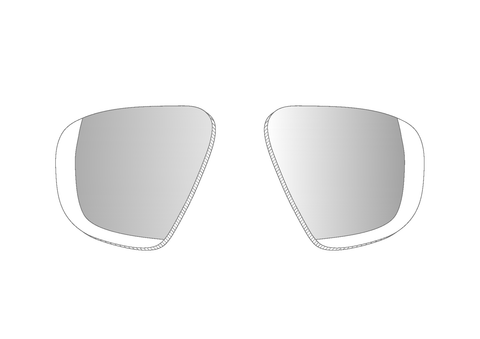
Near-distance lenses are designed for people who need vision correction for close distances. They are typically used by divers who want to read dive computers or see small details underwater.

Progressive lenses
Progressive lenses are designed for people who need clear vision at all distances and normally wear progressive or bifocal glasses.
These lenses allow you to see far, intermediate, and near distances with a single lens. The upper part of the lens provides wide, clear distance vision; the middle part connects the views between the far and near zones and gives us a better sense of orientation, while the lower area helps you focus on closer objects, such as dive instruments.
This is the best option for people over 40 years old because it offers a more natural underwater viewing experience across different visual zones.

Lens thickness, lens upgrades
Depending on your prescription, we offer different lens thickness options with Hi-Index optical lens materials. Thinner lenses help reduce weight and improve optical clarity, especially for higher prescriptions on the edges of the optical lens.
Thin lenses - 1,6 Hi-Index material
This upgrade is for people who have Medium diopters. The lenses are approximately 20% thinner and lighter than standard lenses (1.5 index).
Extra Thin lenses - 1,7 Hi-Index Material
This upgrade is recommended for Mid-High diopters, offering improved comfort and better edge clarity. Approximately 30% thinner and lighter than standard lenses (1.5 index).
Ultra Thin lenses - 1,8 Hi-Index Material
If you have a high diopter, this upgrade is a must. Recommended for high prescriptions where minimizing weight and maximizing optical performance is especially important. The lenses are 30% thinner and lighter than standard lenses (1.5 index). Recommended for high prescriptions where minimizing weight and maximizing optical performance is especially important.
Lens index recommendations
Based on the total prescription strength (including cylinder), we recommend different lens indexes:
-
1.6 Hi-Index – typically used for prescriptions from ±1.50 to ±2.50
-
1.7 Hi-Index – typically used for prescriptions from ±2.00 to ±3.50
-
1.8 Hi-Index – recommended for prescriptions above ±4.00
We also recommend Hi-Index lenses to customers who choose Low-volume masks, as we can reduce the lens thickness so they don't touch their eyebrows or forehead.
Prescription range
We are able to produce a wide range of prescriptions:
-
Distance prescriptions: from +16.00 to -22.00
-
Near addition: from +0.25 to +5.00
We also offer correction for:
-
astigmatism
-
prism correction
-
other special optical requirements on demand
If you have a specific or complex prescription, feel free to contact us directly. Our team will be happy to help!